
Retail inflation hit an eight-month high of 6.07 per cent in February, remaining above the RBI's comfort level for the second month in a row, while wholesale price-based inflation soared to 13.11 per cent on account of hardening of crude oil and non-food item prices, government data showed on Monday. The previous high for retail inflation was 6.26 per cent in June 2021. The consumer price index (CPI) based retail inflation, which is taken into account by the Reserve Bank of India (RBI) while deciding its monetary policy, rose mainly because of costlier food items, as per the data released by the National Statistical Office (NSO).

Dubey demanded the removal of Tharoor, alleging that he was using his position in a discriminatory manner.

The Russia-Ukraine conflict, which has spooked financial markets globally, will set the tone for Dalal Street this week amid concerns over energy prices and foreign fund outflows, analysts said. Participants will also track key macroeconomic signals like GDP estimates and PMI data for manufacturing and services sectors to be announced this week, they added. "With earnings season behind us and given the overall sentiments, markets are expected to move in sync with global peers in the coming week. "A close eye will be kept on the developments concerning the Russia - Ukraine crisis and considering the inflation overhang, market participants will also observe movements in energy prices," said Shrikant Chouhan, Head of Equity Research (Retail), Kotak Securities Ltd.

The country's gross domestic product (GDP) is likely to grow more than 9.5 per cent in fiscal 2021-22, an SBI research report-Ecowrap said. The economy grew at 8.4 per cent in the second quarter of the current fiscal, according to data released by the National Statistical Office (NSO) on Tuesday. The growth in the April-June quarter of this fiscal stood at 20.1 per cent. In October's monetary policy review, the Reserve Bank of India had retained its projection for real GDP growth at 9.5 per cent in 2021-22, consisting of 7.9 per cent in Q2; 6.8 per cent in Q3; and 6.1 per cent in Q4 of 2021-22.

India's GDP estimates for 2020-21 show that the economy is expected to perform much better than earlier projections by different agencies, indicating a sustained V-shape post-lockdown recovery, experts said. The first Advance Estimates (AE) by the National Statistics Office (NSO) has projected a contraction of 7.7 per cent in the real GDP during 2020-21. This was better than the projections by certain international agencies like the IMF and World Bank.
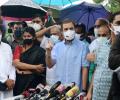
The Orwellian surveillance State is here. And here to stay, asserts Virendra Kapoor.
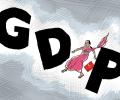
During the six-month period (April-September 2019), the Indian economy grew 4.8 per cent as against 7.5 per cent in the same period a year ago.

Retail inflation inched up to 4.48 per cent in October due to an uptick in food prices, government data showed on Friday. The Consumer Price Index (CPI) based inflation was at 4.35 per cent in September and 7.61 per cent in October 2020.

Retail inflation fell to a five-month low of 4.35 per cent in September from 7.27 per cent in the year-ago period as prices of vegetables and other items declined, according to government data released on Tuesday. The moderation in Consumer Price Index-based inflation is in line with the assessment of Reserve Bank Governor Shaktikanta Das who recently projected substantial softening of retail inflation. The CPI inflation was at 5.3 per cent in August and at 7.27 per cent in September 2020.

In a communication to the ministry of electronics and information technology, the messaging service said it was committed to protecting the privacy of its over 400 million users in India.

WhatsApp, last month, sued Israeli surveillance firm NSO Group, accusing it of helping those buying its spyware Pegasus break into the phones of roughly 1,400 users across four continents.

The comments assume significance in the backdrop of recent disclosures by messaging giant WhatsApp that said Indian journalists and human rights activists were among those globally spied upon by unnamed entities using an Israeli spyware Pegasus.

TMC and other opposition party members rushed into the well of the House as Vaishnaw was called to make a statement over the issue.

The retail inflation rate breached the 6 per cent upper tolerance limit of the RBI for the first time in seven months in January, while the wholesale price index stayed in double-digits for the 10th month in a row, showed two sets of data released by the government on Monday. Retail inflation, the key input for the RBI while reviewing the repo rate every two months, soared during the month mainly because of a spike in certain food items. The previous high for retail inflation was 6.26 per cent in June 2021.

"Justice must not only be done, but also be seen to be done," the Supreme Court observed on Wednesday while declining the Centre's plea to allow it to appoint an expert committee to probe the allegations of use of spyware Pegasus for surveillance of certain people in India.

Former Congress chief Rahul Gandhi, Bharatiya Janata Party ministers Ashwini Vaishnaw and Prahlad Singh Patel, as also former election commissioner Ashok Lavasa and poll strategist Prashant Kishor were among those whose phone numbers were listed as potential targets for hacking through an Israeli spyware sold only to the government agencies, an international media consortium reported on Monday.
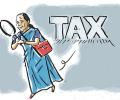
The forthcoming budget needs to delay fiscal consolidation, instead should focus more on supporting the pandemic battered-economy and boost consumption demand by offering income tax soaps and cutting fuel taxes, says a report. In a pre-budget report, India Ratings said it expects the new budget to consolidate and strengthen the plan set out in the last budget, rather than trying out new things by continue with the revenue and capital expenditure pattern of FY'22 to provide stability and consolidation to the past/ongoing efforts, and to focus on boosting demand by generating employment opportunities in areas/sectors that have been impacted more by the pandemic. The report therefore expects the finance minister to delay fiscal consolidation and make it to be a gradual and calibrated process, thus ensuring the necessary fiscal support that the economy needs is available till the recovery acquires its own momentum.
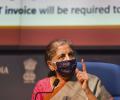
'Without reviving employment, consumer confidence will not go up.'

As per use-based classification, primary good registered a growth of 7.4 per cent, intermediate goods 22.4 per cent, and infrastructure/construction goods 0.1 per cent in February 2020 as against the same period a year ago.

'When the average growth in the last three years was just 2.5%, how does that make us the fastest growing country?' 'They only tell you what has happened in the last 2 years; they are not taking into account what happened in FY21 on account of their mistakes.'

The demand for Tharoor's removal comes days after the Parliamentary Standing Committee on Information and Technology was set to question government officials on the Pegasus spyware issue.

The standoff between the government and the opposition in Parliament has showed no signs of easing after it erupted on the opening day of the Monsoon session on July 19.

Subdued prices of food items like vegetables pulled down retail inflation for the third month in a row to 5.3 per cent in August, within the RBI's comfort zone. While the Consumer Price Index (CPI)-based retail inflation declined to 5.3 per cent in August from 6.69 per cent in the same month a year ago, food inflation dipped at a much faster pace to 3.11 per cent from 9.05 per cent in August 2020. The food inflation was also lower than 3.96 per cent in preceding month of July.
The IT ministry sources said they have received a reply from WhatsApp and are studying it, and that a view on it will be taken soon.

He has also sought a direction to the Centre to take suitable steps to protect Indian citizens from the use of cyber-weapons or malware such as Pegasus.

India's industrial production grew by 1 per cent in December, official data showed on Friday. According to the Index of Industrial Production (IIP) data, the manufacturing sector output grew by 1.6 per cent in December 2020.
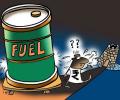
The wholesale price-based inflation accelerated to a record high of 12.94 per cent in May, on rising prices of crude oil and manufactured goods. Low base effect also contributed to the spike in WPI inflation in May 2021. In May 2020, WPI inflation was at (-) 3.37 per cent. This is the fifth straight month of uptick seen in the wholesale price index (WPI)-based inflation. In April, 2021, WPI inflation hit double digit at 10.49 per cent. "The annual rate of inflation, based on monthly WPI, was 12.94 per cent for the month of May, 2021 (over May, 2020) as compared to (-) 3.37 per cent in May 2020.

Citing the massive surge in Omicron infections and the resultant impact on overall economic activities in the March quarter, Swiss brokerage UBS Securities has revised downwards its India's growth forecast for the current financial year to 9.1 per cent from 9.5 per cent earlier. However, UBS Securities does not see the third wave impact extending to the next financial year as it has revised upwards its real GDP forecast to 8.2 per cent, up from 7.7 per cent earlier, expecting the real GDP growth to remain well above the historical average. The World Bank pegs it at 8.3 per cent, unchanged from its June assessment, saying the recovery is not broad-based yet.
The downward surprise in Q2 stemmed from a stronger-than-anticipated drag from gross fixed capital formation and marginal weakness in private final consumption expenditure. In Q3, projection errors emanated mainly from a steep unanticipated contraction in gross fixed capital formation, which was the deepest in the new series of GDP.

Declining vegetable prices brought down the retail inflation to a 15-month low of 4.59 per cent in December and within the comfort zone of the Reserve Bank, government data showed on Tuesday. It is for the first time during the current fiscal that the Consumer Price Index (CPI) based inflation print is below 6 per cent or in the RBI's target range of 2 to 6 per cent. The central bank factors in the CPI-based inflation while arriving at its monetary policy. The inflation in December 2020 came down from 6.93 per cent in November, mainly on account of 10.41 per cent decline in vegetable prices over the year-ago period.

The economic survey for 2020-21 has suggested revision in the weightage of food items to gauge the true picture of inflation in the country, and said new sources of price data also need to be incorporated in the wake of increasing retail e-commerce transactions. As per the survey, the current spike in consumer price-based retail inflation of food prices is mainly a supply-side phenomenon. The survey noted that the weights of all items in retail inflation are based on the NSO household consumption expenditure survey of 2011-12, adding the weight of food items in the index might have significantly decreased over the decade since then.

India's economy recovered faster than expected in the September quarter as a pick-up in manufacturing helped GDP clock a lower contraction of 7.5 per cent and held out hopes for further improvement on better consumer demand. The gross domestic product (GDP) had contracted by a record 23.9 per cent in the first quarter of the 2020-21 fiscal (April 2020 to March 2021) as the coronavirus lockdown pummelled economic activity.

GVA growth in the manufacturing, farm and construction sectors tumbled.

Tharoor put the blame for the logjam in Parliament on BJP and accused the saffron party of reducing the "temple of democracy to a rubber stamp for its agenda or worse, a notice board to announce its unilateral decisions".

Going forward, the February factory output may be impacted as several industries such as automobiles, technology, pharma and fashion have some exposure to imports of raw and intermediate materials from China.

If imputed inflation for April and May is used, then you have inflation of over 6 per cent for two consecutive quarters, which is a worrying signal for the RBI.

There should have been a focus on sanitation and not on littering or garbage. Absence of sanitation affects the health of children, explains Aakar Patel.

One in five students drop out from school.

Modi is seen as exceptional not only on account of his acts but also owing to his style. He appears to sacrifice his life for the people -- like a fakir, a figure he came to epitomize even more in 2020 by growing a long white beard. Charisma is above accountability, and Modi has grasped these dynamics.

Expect a more modest out-turn of around 5 per cent (if not less) because of the longer-term scarring effects of the Covid shock, the sharply slowing growth in the pre-Covid years and some scepticism about the growth-efficacy of some of recent official policy initiatives, explains Shankar Acharya, former chief economic advisor to the government.
